
If you’ve ever leaned in for a cuddle and recoiled at the smell, you’ll know the experience that started this article. A little fishy whiff after dinner is one thing — but a smell so bad it makes you gasp for fresh air is your cat quietly telling you something is wrong. Bad breath, or halitosis, is one of the most common reasons cats end up needing dental treatment, and it’s something I take seriously with my own Siamese, who are particularly prone to sore gums.
This is part of our wider series on dental care for cats. Here we’ll look at what causes bad breath, the gum and dental diseases behind it, and the steps that genuinely keep your cat’s mouth healthy.
What causes bad breath in cats?
Broadly, there are two reasons a cat’s breath turns unpleasant.
Diet — the harmless one. Some foods, especially softer wet foods or raw fish, leave a strong odour for a few hours after eating. This sort of smell is temporary, easy to recognise and easily solved by adjusting what you feed. Nothing to worry about.
Dental and gum disease — the one that matters. If the smell is really bad, present all the time, and genuinely makes you wince before lifting your cat off your lap, it’s almost certainly something more serious that needs your vet’s attention — and the sooner the better. Persistent halitosis is one of the clearest early warnings of disease building up in the mouth.
Poor diet, genetics, stress and age all play a part in feline dental problems. Some cats are simply predisposed and develop trouble younger, and a lack of any oral hygiene routine will, over time, almost guarantee problems.
Gingivitis: where it usually begins
Gingivitis is reddening and inflammation of the gum around the base of the tooth. Some cats have naturally sensitive gums and are far more susceptible — Siamese in particular. My chocolate neuter boy, Coco, is a classic example.
It’s extremely common across all cats, which is why a regular oral routine matters so much: caught early, gingivitis is reversible. Left alone, it escalates.
Not all gingivitis comes down to hygiene, though. Stomatitis is a painful, autoimmune-type condition in which the cat’s body mounts an exaggerated response to plaque and bacteria, leaving the gums severely inflamed. The exact cause isn’t fully understood, but cats with FIV (feline immunodeficiency virus) and FeLV (feline leukaemia virus) are particularly vulnerable.
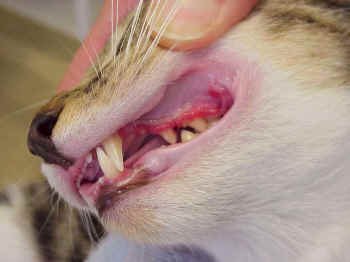
Periodontal disease: the serious progression
Periodontal disease (gum disease) is the most common clinical condition in adult cats — and it’s almost entirely preventable. The frustrating part is that, beyond bad breath, there are often very few signs an owner can spot, so professional treatment frequently comes too late to save teeth.
The real trouble develops as plaque and tartar (calculus) spread beneath the gum line. Plaque is a sticky bacterial film that forms on the teeth; left undisturbed it hardens into yellow-brown tartar where the tooth meets the gum. The bacteria below the gum set off a cycle of damage to the tissues supporting the tooth, eventually leading to tooth loss.
Worse, this isn’t just a mouth problem. The gums have a rich blood supply, so bacteria can be carried to organs such as the liver and kidneys, contributing to damage elsewhere in the body as a cat ages.
Symptoms to look out for
Cats are experts at hiding discomfort, which is exactly why regular check-ups matter. Watch for:
- Bad breath — usually the first thing owners notice
- Yellow-brown deposits along the teeth
- Red, swollen or bleeding gums
- Drooling or pawing at the face
- Reluctance to eat, or favouring soft food over hard
- Loose or missing teeth
- Lethargy or hiding away
If you’re noticing any of these, it’s a vet visit — not a wait-and-see.
How vets treat dental disease
Treatment depends on how advanced things are. Early cases (mild gingivitis with light plaque) are usually resolved with a professional scale and polish under anaesthetic, removing tartar above and below the gum line. More advanced disease may need root planing, removal of diseased tissue, or extraction of teeth that can’t be saved. Your vet will assess and advise — and I’d never recommend trying to tackle established dental disease at home.
Afterwards, your vet will set up a maintenance routine, which may include brushing, a dental diet, and sometimes pain relief or antibiotics for more serious cases. Owner commitment to that aftercare is what keeps it from coming straight back.
Prevention is far better than cure
The good news is that most of this is preventable with a steady routine:
- Keep up annual vet check-ups and vaccinations — a professional can spot trouble early
- Check your cat’s mouth and gums regularly yourself
- Feed some dry, hard kibble, which helps scrub plaque from teeth (switch to semi-wet if your cat has very sensitive gums)
- Brush with a cat-specific toothbrush and paste — never human toothpaste
- Consider an oral hygiene water supplement
A couple of times a week is usually plenty. For the bigger picture on feline wellbeing, our cat nutrition advice and the breed-specific Siamese cat breed profile are both worth a look. The charity Cats Protection also has excellent, reliable guidance on feline dental disease.
Keep your cat’s smile healthy
From dental care to nutrition, explore our full set of practical cat health guides.
Frequently asked questions
Is it normal for a cat to have bad breath?
A faint food smell shortly after eating is normal and harmless. Persistent, strong bad breath is not — it’s usually a sign of gum or dental disease and warrants a vet check.
Can I get rid of my cat’s bad breath at home?
If it’s diet-related, switching foods may help. But if the smell is constant and strong, the cause is in the mouth and needs veterinary treatment first. Home brushing then helps keep it from returning — it isn’t a cure for existing disease.
Does dry food really help dental health?
Hard kibble can help scrub away some plaque as your cat chews, so it’s a useful part of the picture. It isn’t a substitute for brushing and check-ups, though, and cats with very sore gums may need softer food instead.
How often should I brush my cat’s teeth?
A couple of times a week makes a real difference. Use a cat-specific brush and paste, introduce it gently and gradually, and never use human toothpaste, which is toxic to cats.
Written from years of living with and loving Siamese cats. Find out more about me and this site.