
At one day old a kitten is a warm, squeaking jelly bean that cannot see, cannot hear and cannot keep itself warm.
Thirteen weeks later it is climbing your curtains, ambushing your ankles and ready for a home of its own.
In between, a lot happens very fast, and as the breeder you are watching for the things that are going right and the things that are not. This is the week-by-week guide I would hand a new breeder: what normal kitten development looks like from birth to 13 weeks, what you should be doing at each stage, and the signs that mean you pick up the phone to the vet.
Here is the whole thirteen weeks on one screen. The detail for each stage follows underneath.
| Age | What you will see | Your job |
|---|---|---|
| Week 1 | Eyes closed, ears folded, feeding and sleeping | Weigh daily, keep the nest warm and quiet |
| Week 2 | Eyes opening, always blue | Keep weighing, wipe sticky eyes |
| Week 3 | Ears up, first wobbly steps, first teeth | Start gentle daily handling |
| Week 4 | Interest in mum’s food, first tray visits | Begin weaning, add a shallow tray |
| Weeks 5 to 7 | Running, climbing, play-fighting | Socialise: people, noise, handling |
| Week 8 | Mostly weaned, real personalities | Start notes for each new owner |
| Weeks 9 to 12 | First and second vaccinations | Keep the routine, keep other cats out |
| Week 13 | Ready to leave home | Paperwork, microchip, kitten pack |
Before you start: get a proper scale
A kitchen scale that reads to 1g. Not the bathroom scale, not the parcel scale, not “they look fine”.
Weigh every kitten at the same time every day for the first fortnight and write it down. Weight is the earliest warning you get. A kitten that loses weight between two weigh-ins, or stays flat while its littermates gain, is the one to watch, often before it looks any different at all.
You will feel slightly ridiculous with a notebook full of grams. Do it anyway. (You will also find yourself telling people at dinner that the little tabby put on 14g yesterday. Nobody cares. Tell them anyway.)
How much should a kitten weigh? A week-by-week guide
Veterinary references put a typical kitten’s birth weight at around 90 to 110g, with a normal range of roughly 80 to 140g. Healthy kittens gain about 10 to 15g a day in the early weeks and should double their birth weight before they are two weeks old. A kitten born under 75g is in the highest-risk group, so that one gets the closest watching.
Here is what those figures look like in practice. I have worked the table out from the 10 to 15g a day rule for a kitten born at 100g, and from the guidance that kittens go on gaining roughly 100g a week after that. It is a guide, not a target: every line and every litter is a little different, and your own notebook is worth more than anybody’s chart.
| Age | Rough weight | What matters most |
|---|---|---|
| Birth | 90 to 110g | Record it within the first few hours |
| Day 7 | 170 to 205g | Steady daily gains, no losses |
| Day 14 | 240 to 310g | At least double the birth weight |
| Week 3 | 310 to 415g | Gains keep pace with littermates |
| Week 4 | 380 to 520g | Weaning starts; keep weighing daily |
| Week 8 | roughly 750 to 900g | Eating solids well, gaining weekly |
| Week 13 | roughly 1.2 to 1.4kg | Weigh weekly; steady upward line |
The numbers I care about most are not the totals but the direction. A kitten on the small side that gains every single day is usually less of a worry than a big one that has gone flat.
Any weight loss after the first day is a reason to ring your vet, not to wait and see.
Week 1: eat, sleep, stay warm
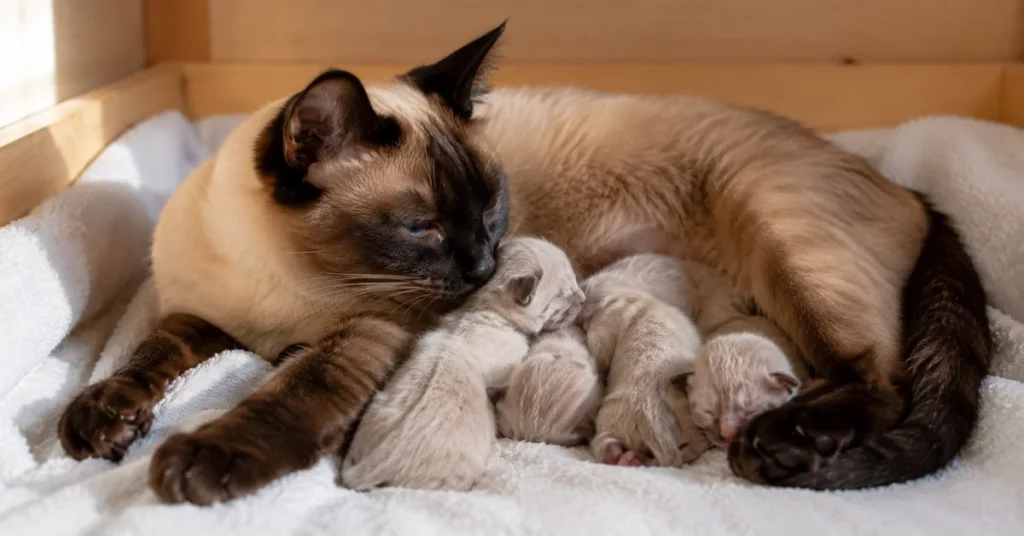
Newborn kittens are born with their eyes closed and their ears folded down. They cannot regulate their own temperature, so they depend on the queen and on each other, and a kitten that ends up on its own at the edge of the bed chills quickly.
Your job is simple and relentless: check every kitten is latching and feeding, keep the nest warm and draught-free, and weigh daily. Leave the queen to do the rest. A good queen does not need your help, she needs your quiet.
Two things catch new breeders out this week.
Newborns cannot shiver. The shiver reflex only arrives at around six to eight days old, so a cold newborn does not tell you it is cold. It just goes quiet. A kitten that feels cool to your hand needs warming slowly and your vet ringing, and it should be warm before anyone tries to feed it. A normal newborn’s body temperature is a little lower than an adult’s, around 36 to 37°C, and climbs to adult levels over the first month.
They cannot wee on their own. The queen licks under the tail to make each kitten pass urine and faeces, and kittens keep that reflex for their first five weeks or so. If she is not doing it, you will need to, with a warm damp cotton wool pad after each feed, and your vet should know.
If you breed Siamese, this is also the week you discover your kittens are white. Every one. The points come in over the coming weeks because the colourpoint gene only produces pigment in the cooler parts of the body, and the womb is warm all over. My lesson on why Siamese cats are pointed explains the whole thing.
Week 2: when do kittens open their eyes?
Most kittens open their eyes between about seven and fourteen days old. Usually one at a time, and usually looking a bit cross about it. Their sight is blurry for the first couple of weeks after that, so do not expect them to track a toy yet. Wipe gently with cooled boiled water if any are sticky, and call your vet if an eye looks swollen, crusted shut or weepy.
Keep weighing. Keep the room warm.
And resist the urge to tell the buyer on your waiting list what colour their kitten is. Seal and chocolate, or blue and lilac, can be genuinely hard to call this early. Wait until the points have something to show you.
When do kittens’ eyes change colour?
Every kitten’s eyes are blue when they first open. In most breeds the adult colour starts to show from around six or seven weeks and keeps settling for months after that.
Siamese and Balinese are the exception: the blue is the adult colour, and it stays. Most Orientals go green, which is one of the first clues in a mixed Siamese and Oriental litter as to who is who.

Week 3: ears up, first wobbly steps
By the third week the ears are starting to unfold and the kittens begin to react to sound. They push up onto their legs and wobble about like tiny drunks leaving the pub. The ear canals open during the first fortnight, so by now most kittens jump at a dropped spoon.
When do kittens get their teeth, and do they lose them?
The first milk teeth, the tiny front incisors, come through at around two to three weeks, and a kitten has its full set of 26 by about six to eight weeks. Those are temporary. The adult teeth start pushing them out from around three to four months, and most cats have all 30 adult teeth by six or seven months.
So yes, kittens lose their teeth. Usually after they have gone to their new homes, which is worth telling your buyers before they find a tooth in the carpet and ring you in a panic.
This is also roughly when the socialisation window opens, and it does not stay open for long. From now on, gentle daily handling by different people, normal household noise and new textures all count. My article on socialising kittens, and why sooner is better covers how I go about it.
Week 4: solid food and the litter tray
Around four weeks the kittens start taking an interest in the queen’s food, which is your cue to begin weaning. I go through it stage by stage in my week-by-week guide to weaning kittens, so I won’t repeat it here.
Put a shallow litter tray in the nest area now. Most kittens get the idea by watching mum. Some take a week longer and redecorate first.

How to sex a kitten (and why you should check twice)
You need to know the sex of every kitten before you register the litter, and the new owner will want to know long before that. Sexing newborns is genuinely hard, and plenty of experienced breeders have announced a boy who turned out to be a girl. (The waiting list never forgets.)
Lift the tail gently and look at the two openings under it. In a female they sit close together, a bit like an upside-down exclamation mark. In a male there is more space between them, where the testicles will be, so it looks more like a colon. Comparing littermates side by side makes it much easier, and it gets clearer with every week, so check again at three or four weeks before you tell anyone.
Colour can help too. Tortie points (and tortie Orientals) are almost always female, because of the way the red gene is carried. My lesson on Siamese tortie point genetics and the sex-linked red gene explains why.
The sex goes on the registration, so get it right before you fill in the form. My guide to registering a litter with the GCCF covers the rest of the paperwork.
Weeks 5 to 7: the chaos weeks
Somebody flicks a switch. The kittens run, pounce, climb, fall off things and climb them again. Play-fighting starts in earnest, and the queen begins teaching manners by walking away when the feeding gets rough.
This is the busiest stretch of socialisation and the one with the biggest payoff. A kitten that meets visitors, hears the hoover and gets picked up, turned over and looked in the mouth now becomes the adult that copes with the vet, the show hall and a family with children.
It is also when the house starts to look like a bomb has hit it. Budget for it emotionally.
The stages behaviourists talk about
If you read anything on cat behaviour you will meet these names, so here is how they line up with the weeks in this guide. The ages are approximate and every kitten moves at its own pace.
| Stage | Roughly | What is happening |
|---|---|---|
| Neonatal | Birth to 2 weeks | Feeding, sleeping, eyes and ears opening |
| Socialisation | 2 to 7 weeks | Walking, teeth, learning who and what is safe |
| Play | 7 to 14 weeks | Running, climbing, full coordination, growing independence |
| Juvenile | 3 to 6 months | Working out their place among the other animals and people at home |
| Adolescence | 6 to 18 months | Testing boundaries; entire cats start to show sexual behaviour |
The one that matters most to a breeder is the socialisation stage, because it is almost entirely in your hands. By the time a kitten leaves you, it is closing.

Week 8: mostly weaned
By around eight weeks most kittens are eating solids happily and nursing far less. They are using the tray reliably (mostly), and you can see real personalities: the bold one, the thinker, the one who sits on your feet.
Start your notes on each kitten for its new owner. You will remember who is who. Their new family will not, and they will want to know which one was first to the food bowl.
Weeks 9 to 12: vaccinations
In the UK the primary course is most commonly given at 9 weeks and 12 weeks, though your vet may adjust it. My UK breeder’s guide to kitten vaccinations explains what each injection covers and why the timing matters so much.
Keep socialising and keep the household normal. The protection a kitten borrowed from its mother is fading during these weeks, so this is not the time for visitors bringing in other cats, or for a kitten’s first trip anywhere it does not need to go.
Weeks 12 to 13: when can kittens leave their mother?
The GCCF guidance is that kittens should be at least 13 weeks old before they leave the breeder. My own kittens never leave sooner than 13 weeks. Not 12 and a half because the buyer is going on holiday. Thirteen.
Thirteen weeks is not an arbitrary number. By then a kitten has had both vaccinations with time for the protection to build, has been fully weaned for weeks, and has learned its manners from its mother and littermates. A kitten taken at eight weeks misses the part where its siblings teach it that biting hurts.

By now you are looking for a kitten that is fully weaned, confident, using the tray, a sensible weight for its build, and through its vaccination course with time for the protection to build. Microchipped, registered, paperwork ready. My guide to registering a litter with the GCCF covers the paperwork side, and my kitten pack ideas cover what goes home in the bag. If you want your kittens leaving in something better than a carrier bag from the supermarket, the kitten pack bags in my shop were made for exactly this.
After 13 weeks: what your buyers will see next
Your kitten’s development does not stop at the front door, and your buyers will ring you about every bit of it. Tell them now:
- Teeth: the milk teeth start falling out from around three to four months. They may find one. It is normal.
- Growth: a kitten keeps growing steadily and is usually treated as adult at around a year old.
- Adolescence: from about six months to eighteen months, expect a teenager: boundary-testing, mad half-hours and sometimes a little less cuddling.
- Settling down: most cats have their adult personality by about two.
A short paragraph on this in your kitten pack saves you a lot of worried phone calls in month five.

When to call the vet, at any age
Some things do not wait for the morning. Ring your vet straight away if a kitten:
- feels cold to the touch, or is limp and floppy
- will not feed, or cries weakly and constantly
- has lost weight between weigh-ins, or not gained for a day in the first week
- has diarrhoea that lasts, or is struggling to breathe
- is being pushed out of the nest by the queen
- weighed under 75g at birth and is falling behind its littermates
Newborn kittens can go downhill in hours, not days.
I have written about the two emergencies every breeder should know before they need them: spotting and treating hypoglycaemia in kittens, and tube feeding orphaned or rejected kittens. Read them now, while everyone is fine. You do not want to be learning it at 2am.
This guide is general information for breeders, not veterinary advice. If you are worried about a kitten, your vet is the right call, every time.
Kitten development: quick answers
When do kittens open their eyes?
Usually between seven and fourteen days old, one eye at a time.
When can kittens leave their mother?
GCCF guidance says no sooner than 13 weeks. Mine never go earlier.
Do kittens lose their teeth?
Yes. Milk teeth are replaced by adult teeth from around three to four months, and most cats have all 30 adult teeth by six or seven months.
When do kittens start using a litter tray?
From around four weeks, usually by copying mum. Put a shallow tray in the nest area.
How much weight should a kitten gain each day?
Around 10 to 15g a day in the first weeks, doubling its birth weight before two weeks old. A loss after the first day is a reason to ring your vet.
Can newborn kittens keep themselves warm?
No. They rely on the queen and their littermates, and they cannot shiver until about a week old, so a cold kitten goes quiet rather than complaining.
When can you tell a kitten’s sex?
You can try at birth, but it is far more reliable from three to four weeks. Check twice before you tell the buyer.
Where this fits
This is one stage of the whole journey, from choosing a queen to waving the last kitten off. The rest is in my complete guide to breeding Siamese cats.
I’m writing a book for new breeders, Your First Litter, that takes you through all of it, week by week. Join the list below and you’ll hear the moment it’s ready.