
Here is the Siamese cat personality in one sentence: they talk, they follow you about, and they will have an opinion on whatever you happen to be doing.
That is not a warning label. It is the reason people like me end up with a house full of them.
I have bred Siamese and Orientals under my Burnthwaites prefix for more than twenty years, I judge for the GCCF, and I am a certified feline behaviourist, so I see this breed from three directions: in my own kitchen, on the show bench, and in the homes where something has gone wrong. This guide is what living with a Siamese, an Oriental or a Balinese is really like, the good, the loud and the slightly ridiculous. If you are still deciding whether to get one at all, my honest guide to whether a Siamese is right for you (it has a quiz) is the better place to start. This page is for what comes next.
Same cat, three coats
People treat these as three breeds. Personality-wise, they are one cat in three outfits.
The Siamese is the pointed one: pale body, coloured mask, ears, legs and tail, blue eyes. The Oriental is the same cat with the colour allowed to run all over, so you get solid blacks, chocolates, reds, torties and tabbies (I have explained the gene that makes the difference in my article on why Siamese cats are pointed). The Balinese is the Siamese with a longer, silky coat and a plumed tail.
Here is the proof, from my own house, as I write this in November 2026.
Our boy Cash sired two litters this autumn, to two sisters. Daisy had five kittens: three Siamese and two Orientals. Midnight had seven: four Siamese and three Orientals. In each litter: same mum, same dad, same box, same week of first wobbly steps. Some came out pointed and some came out in a full-colour coat. Same breed group, same temperament, different coats.
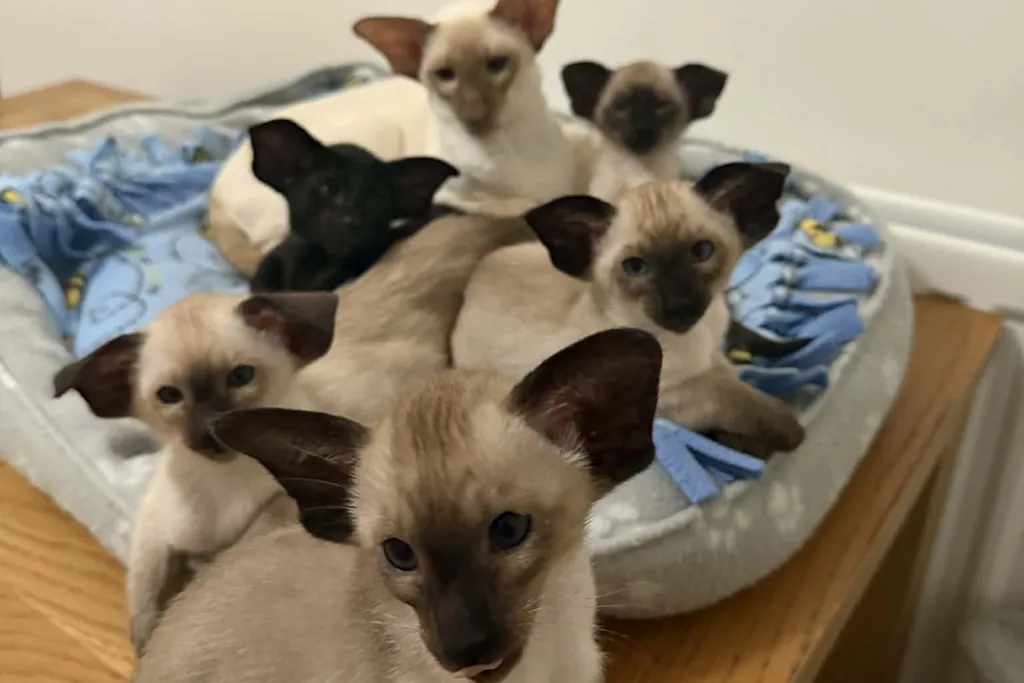
So when I describe the Siamese personality below, read it as the Oriental and Balinese personality too. The differences between these three are in the coat and the grooming, not in the character.
Here is the side-by-side, so you can see exactly where they differ and where they do not:
| Siamese | Oriental | Balinese | |
|---|---|---|---|
| Coat | Short, fine, close-lying | Short, fine, close-lying | Semi-long and silky, no woolly undercoat, plumed tail |
| Pattern | Pointed: pale body, darker mask, ears, legs and tail | Colour all over: solids, tabbies, torties, bicolours and more | Pointed, like the Siamese |
| Eyes | Blue | Green, in varying shades (whites and bicolours green, blue or one of each; pointed bicolours blue) | Blue |
| Grooming | A soft brush once a week | A soft brush once a week | A good comb a couple of times a week |
| Voice | Loud and chatty | Loud and chatty | Loud and chatty |
| Need for company | Very high | Very high | Very high |
| Personality | Clever, sociable, demanding | The same | The same |
The look matches the character
You can read a fair bit of the personality off the cat itself. On my cattery site I describe them as long and slender medium-sized cats that are extremely intelligent and can also be very demanding, and the build is the first half of that sentence. Long legs, a long whippy tail, big ears and almond-shaped deep blue eyes that follow you round the room. Orientals have green eyes, in every shade from pale to deep. White Orientals and Oriental bicolours can have green eyes, blue eyes or one of each, and pointed Oriental bicolours have blue.
That is the body of a climber and a sprinter, not a sofa cushion. A Siamese will be on top of the fridge before you have finished saying “not on the fridge”, and the eyes are already looking for the next shelf. My Siamese breed profile and colour guide covers the point colours if you want the full tour.
Siamese cat personality traits at a glance
If you only have a minute, these are the six traits that every Siamese, Oriental and Balinese owner will recognise:
- Intelligent. Quick to learn, quick to get bored, and quicker still to work out how the cupboard opens.
- Sociable. They want people, and usually other cats, in the same room as them.
- Affectionate and loyal. Strong bonds, often with one favourite person who never gets a moment’s peace again.
- Communicative. Vocal, opinionated and happy to tell you about it.
- Active and playful. Kitten-like for years, not months.
- Demanding. Attention is not a treat to them, it is a basic right.
Each of those has a good side and a hard side, and the rest of this guide takes them one at a time.
They talk. A lot.
If there is one trait people underestimate, it is this one. A Siamese has a big voice, a wide vocabulary and absolutely no sense of when to keep it down.
They greet you at the door. They answer back when you speak to them. They protest at closed doors on principle (they do not necessarily want to go through, they just object to it being shut). They narrate your cooking, your phone calls and, if you let them, your sleep.
For some people this is the best thing about the breed. For others it would be the end of a beautiful friendship by Wednesday. Neither is wrong. The noise has its own reasons, and most of the loudest cats are telling you something specific, so I have given it a page of its own: why Siamese cats are so loud, and what actually quietens them down.
Velcro with whiskers
A Siamese does not want to be near you. It wants to be on you, ideally while you are trying to do something else.
Expect a cat on your shoulder while you cook, on the keyboard while you work and under the duvet while you sleep. Expect an escort to the bathroom. Expect to be chosen: a Siamese will love the whole household, but it usually picks one favourite person, and that person rarely gets to go to the loo alone again.
One girl I bred went to a young couple in Sheffield, and the photos they sent me were nearly all of her pressed against one of them, or perched on their heads while they tried to watch television. They did not mind in the least. (I have told that story properly in my CattyLicious guide to the Siamese personality.)
This is why the most common question I get from new owners is about leaving the cat at home. The short answer is that an adult Siamese can cope with a normal working day if it has food, water, toys and something to do, but it cares far more than most breeds about whether anyone is coming back. Kittens are a different matter. I have set out the details, the signs of a cat that is not coping, and what helps, in my guide to whether Siamese cats can be left alone.
Clever enough to be a nuisance
Siamese and Orientals are bright, and bright cats get bored.
A bored Siamese will invent its own entertainment, and you will not like its choices. Cupboards get opened. Loo rolls get unravelled. Anything balanced on a shelf is, in the cat’s opinion, a challenge. The same brain that causes the trouble also makes them easy to train: plenty learn to fetch, sit for a treat and walk on a harness, and they take to clicker work quickly because it is attention and a puzzle at the same time.
Put the brain to work and you get a delightful cat. Leave it idle and you get a demolition crew with blue eyes. My article on keeping indoor cats happy has the enrichment ideas that work best with this breed.
Training works best with patience, consistency and rewards. Keep sessions to a few minutes, end on something the cat gets right, and never punish a mistake: a Siamese that feels told off will simply stop playing your game and start one of its own. Clicker training suits them down to the ground, and my Siamese behaviour and training guide goes through it.
Better in pairs? Usually, yes
They love company, ours included, other cats included. On my cattery site I put it as plainly as I can: Siamese and Orientals do well in pairs rather than being the only cat in the home.
A second cat is not compulsory, and it is not a fix for a cat that is left alone for twelve hours. But for a household that is out for part of the day, two Siamese (or a Siamese and an Oriental, which is the same thing in a different coat) keep each other busy, warm and entertained. How to choose the second cat and how to introduce them without starting a war is in my article on whether Siamese cats get along with other cats.
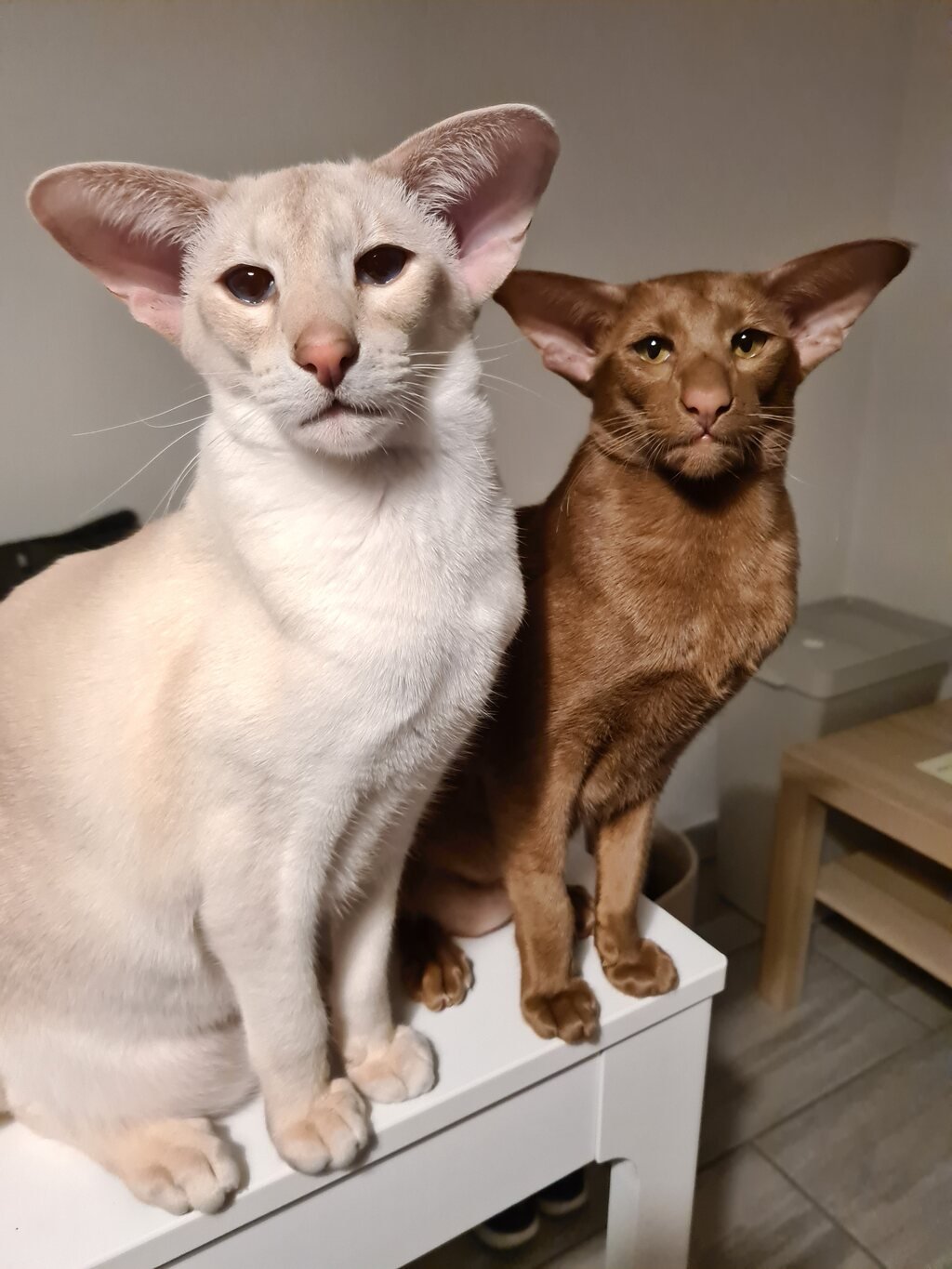
Children, other cats and dogs
A Siamese adopts the whole household, so the family matters as much as the cat.
They are usually good with gentle, respectful children and often gravitate to the busiest, most fun person in the house. The rules are the same as for any cat: teach children to handle the cat kindly, and make sure it always has a high, quiet place to escape to. With other cats they generally do well, especially another Siamese or Oriental. With dogs it depends far more on the dog than the cat. A calm, cat-friendly dog and a careful introduction usually end in friendship, and my article on whether Siamese cats are good with dogs explains how to do it.

Are Siamese cats friendly?
Very. They are one of the most people-focused breeds there is. They will greet visitors, investigate handbags and settle on the lap of the one guest who says they do not like cats.
What they are not is aloof. (They would be hacked off to hear the word used about them.) If you want a cat that potters about and only really wants to know you at mealtimes, a Siamese will baffle you, and you will baffle it.
What gets read as bad temper is nearly always something else. In my behaviour work, the “difficult” Siamese is usually a bored, lonely or over-tired one, or one in pain, and once that need is met the cat underneath is as soft as butter. If your cat has changed, rather than simply being loud, read my guide to stress in cats and talk to your vet.
If you think yours is anxious rather than simply full-on, my book The Calm Cat takes you through calming an anxious cat step by step.
Kitten or adult: does the personality change?
Less than you might hope, if you were hoping for calm. Siamese stay kitten-like for years, and plenty of ten-year-olds still race round the house at midnight for no reason anyone can explain.
What does shape the adult cat is the first thirteen weeks. A kitten raised in a busy home, handled every day and used to the noise of the hoover and the doorbell, grows into a confident, sociable adult. One raised out in a shed is far more likely to be nervous, whatever its pedigree says. That is why I would always choose a breeder who rears kittens in the house, and why ours never leave before thirteen weeks. My article on socialising kittens explains what good breeders do in those weeks, and the breeders and kittens directory is the place to start looking.
Older Siamese do slow down a little, but the need for company does not go anywhere. If anything, a senior Siamese wants more warmth, more lap time and more routine than it did at five. Keep play gentle and little and often, and keep an eye out for changes, which is the next point.
When a change in personality is a health question
A Siamese that has always been loud is a Siamese. A Siamese that has suddenly gone quiet, hides, stops eating, turns grumpy or starts yowling at night is telling you something different.
Cats hide illness well, and a change in behaviour is often the first sign. If your cat’s personality changes, ring your vet before you ring a behaviourist. My Siamese health guide covers the breed-specific problems worth knowing about.
Living with an Oriental
Everything above applies, in a different coat. Orientals come in a huge range of colours and patterns, which is half the fun, and the short coat is as easy to care for as a Siamese one: a stroke with a soft brush or a grooming mitt once a week and you are done.
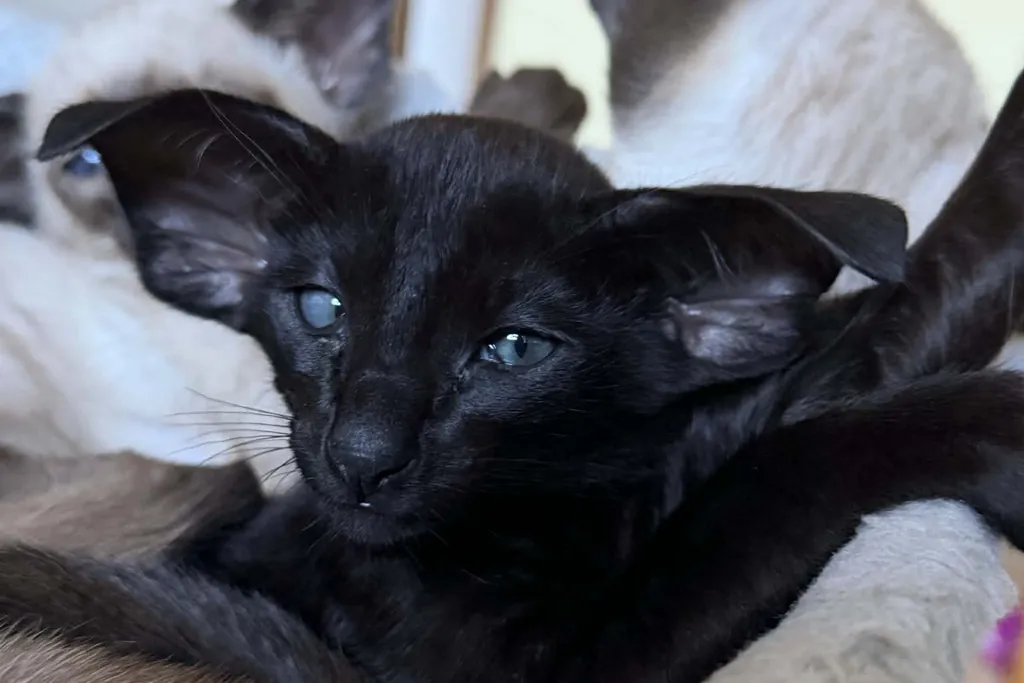
If you are torn between the two, choose on looks and on the individual kitten. Coat colour does not buy you a quieter cat: the voice comes with the breed group, not the paint job.
Living with a Balinese
The Balinese is the Siamese in a longer coat, and the voice, the cleverness and the need for company all come with it.
The coat is the real difference. It is silky and lies close, without the thick woolly undercoat that makes some longhaired breeds mat if you look at them wrongly, so a couple of good combs a week usually keeps it right. Expect more fur on your clothes than you would get from a Siamese, and more on the sofa (which the cat will regard as its sofa anyway). If you want the GCCF names and codes for the Balinese colours, they are in my guide to Siamese and Balinese GEMS codes.
The daily routine that keeps the peace
None of this needs to be hard work. It needs to be regular, and it needs about twenty to thirty minutes a day of real, focused attention on top of simply being in the same room.
Play with your cat every day, properly, with a wand toy it can chase and catch, ideally in two short sessions rather than one long one. Feed some meals from a puzzle feeder so the brain gets a workout as well as the stomach. Give it height: a tall cat tree or a couple of shelves near a window. Keep a routine, because a Siamese that knows when things happen is a calmer Siamese.
And keep it safe. Ours are indoor cats with an enclosed outdoor run, and we do not let them free roam. A trusting, people-loving cat that will happily follow a stranger is not a cat I would want near a road. My honest take on indoor or outdoor cats explains the reasoning.
For the bigger picture of training, toileting and behaviour problems, my Siamese behaviour and training guide covers the lot, and the Siamese owner’s guide covers feeding, health and costs.
Living with a Siamese: the dos and don’ts
If you remember nothing else from this page, remember these:
| Do | Don’t |
|---|---|
| Play properly every day, ideally twice | Assume a cat tree on its own is enough |
| Give it height, a window and something to watch | Leave it in a bare room all day |
| Talk back, it is half the fun | Shout at it for talking, it will just think you have joined in |
| Reward quiet and calm | Hand over breakfast to stop the yelling |
| Think hard about a second cat if you are out a lot | Leave one alone for twelve hours and hope |
| Keep it indoors or in a secure run | Let it wander near roads |
| Call the vet when the behaviour changes | Put every change down to “just being Siamese” |
Who should not get one
I say this on my own cattery site and I will say it here, because it matters more than any sale.
If you would rather have a quieter, less demanding cat that is happy to get on with its own day, a Siamese, Oriental or Balinese is the wrong choice. That is not a criticism of you. It is a mismatch, and a mismatch is hard on everyone, the cat most of all.
The saddest calls I take are not about sick cats. They are about perfectly normal Siamese in homes that wanted a different cat.
If that sounds like you, look at a calmer breed. We breed British Shorthairs in the same house, and they have a great deal less to say for themselves. If it does not sound like you, if the talking and the following and the opinions made you smile, you are exactly who this breed was made for. You will find breeders and kittens from across the UK in our Siamese and Oriental breeders and kittens directory.
Siamese personality questions I get asked
Are Siamese cats aggressive?
Not by nature. They are one of the most people-loving breeds there is. What looks like aggression is nearly always boredom, frustration, over-excitement in play or pain, and a cat that suddenly turns grumpy should see the vet first.
Are Siamese cats good with children?
Usually, with gentle, respectful children. Toddlers are harder, as they are for any cat, so supervise, teach kind handling, and make sure the cat can get up and away.
Do Siamese cats like being picked up and held?
Most like close contact far more than the average cat: shoulders, laps and the warm spot on your pillow. Being grabbed and held still is another matter, so let the cat choose.
Do Siamese cats get jealous?
They notice exactly where your attention goes, and some will push in between you and a new partner, baby or cat. My article on Siamese cats and other cats covers jealousy in multi-cat homes.
Male or female, which is more affectionate?
For a neutered pet there is little in it. The individual kitten matters far more than the sex, so choose the personality in front of you.
Are Siamese cats hypoallergenic?
No cat is, but the short coat sheds less than many breeds. I have written a full answer in my guide to whether Siamese cats are hypoallergenic.
How long do Siamese cats live?
They are a long-lived breed, often well into their teens, so you are signing up for the long haul, voice and all.
The book I am writing about this
Every question on this page is one that owners keep asking: the noise, the clinging, the cat that pees on the bed when you go away for the weekend, whether to get two. So I am writing a book about living with Siamese, Orientals and Balinese. It is not out yet. Join the newsletter below and you will hear about it first.
If your cat is already anxious or unsettled, my book The Calm Cat is out now and covers stress and anxiety in cats of every breed. And if you want more of my day-to-day view, I have written about what it is like living with a Siamese on my CattyLicious site too.