
Let me save you some time and some money: you cannot train the voice out of a Siamese.
Nobody can, and anyone who tells you otherwise is telling porkies. I have bred Siamese and Orientals for more than twenty years and I am a certified feline behaviourist, and I would not even try.
What you can do is change what the noise is about, how often it happens and when. Most of the loud Siamese I am asked about are not loud for no reason. They are loud because the noise works. Here is why they do it, which noises are worth worrying about, and what genuinely brings the volume down.
One of my kitten owners once rang me convinced there was something wrong with her new kitten, because of the racket it was making. There was nothing wrong with it at all. It was complaining about breakfast. (Full story in my CattyLicious piece on the Siamese personality.)
It is a breed trait, not a fault
Siamese and Orientals are a talkative breed group. A Siamese that never said a word would be the odd one out.
So the starting point is acceptance. If you want a silent cat, this is the wrong breed, and no amount of advice on this page will change that (my guide to the Siamese cat personality explains what else comes in the package). If you love the chatter but want less of it at 5am, read on.
What your Siamese is actually saying
Most Siamese noise falls into one of five boxes, and each one needs a different answer.
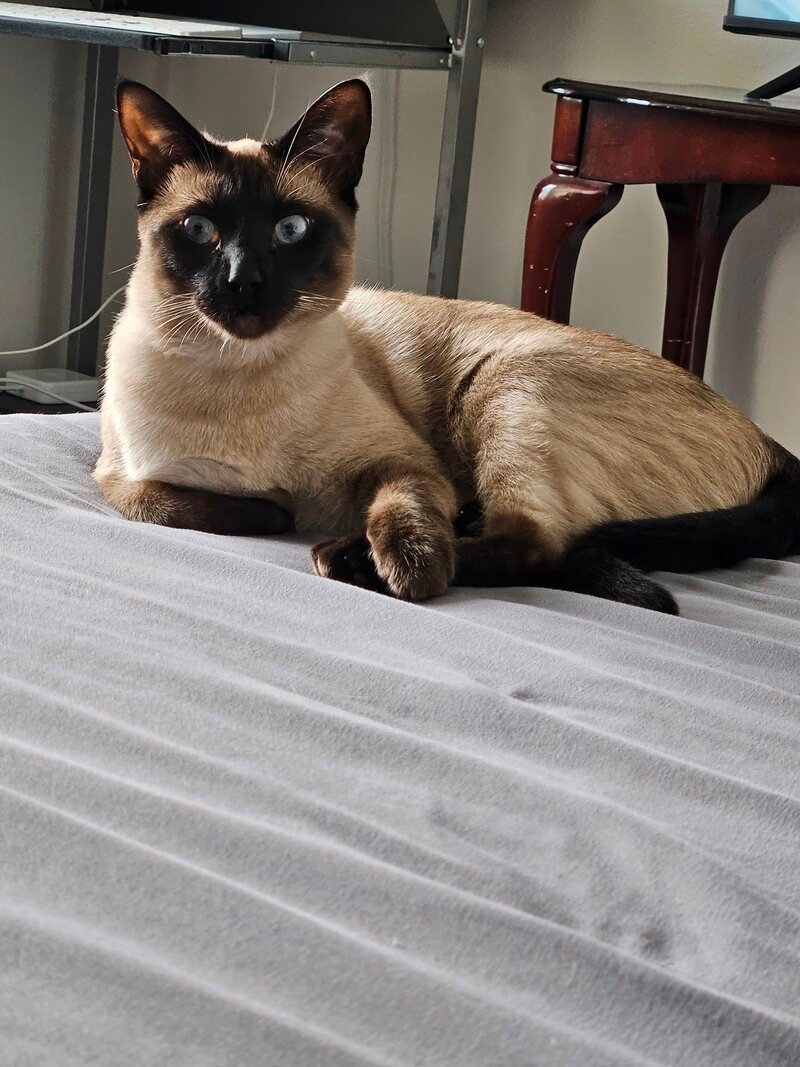
“Hello, you’re back”
The greeting. Loud, long and usually delivered while winding round your legs. This one is lovely and you should do nothing about it except say hello back.
“I want something”
Food, a door opened, a lap, a game. The demand meow is the one that gets out of hand, because it is the one we reward. The cat yells, we get up, the cat learns that yelling gets you up. Simple as that.
“I’m bored”
A Siamese with nothing to do will make something to do, and the first thing it usually makes is noise. If the talking gets worse on the days you are busy or out, boredom is your answer.
“I’m calling”
An unspayed female in season is a different sound altogether: louder, lower, more desperate, and it goes on for days. If you have never heard it, you will know it when you do (so will the neighbours). I have written about it in detail in my article on cats in season and what calling sounds like. If she is a pet and you are not breeding from her, spaying stops it, and your vet will advise on timing.
“Something is wrong”
This is the one that matters. A cat whose voice changes, rather than one that has always been loud, is telling you something different.
The secret language
Here is the bit nobody warns you about. After a few months, you start to understand it.
The short chirp that means dinner. The long, offended one that means you have shut the bedroom door again. The quiet trill when you come in from work, which is the closest a Siamese gets to saying it missed you. Owners end up having full conversations with these cats, and the honest truth is that most of us would not swap it for silence.
That is also why the noise is worth listening to rather than just putting up with. Once you know your cat’s vocabulary, you notice straight away when a new word turns up.
Are some Siamese louder than others?
Yes. Individuals vary, and some are positively restrained (by Siamese standards, which is still loud by anyone else’s). An entire cat, male or female, is louder than a neutered one, because calling and the urge to roam add a whole new range of noise. Orientals and Balinese are the same breed group, so do not choose one hoping for a quieter cat.
The quietest Siamese tend to be the ones with company, a routine and enough to do. The loudest are usually the bored ones.
The Siamese noise decoder
Pin this to the fridge:
| The noise | What it usually means | What to do |
|---|---|---|
| Short chirp or trill | Hello, or “follow me” | Enjoy it and answer back |
| Repeated loud meow at you | “I want something”: food, a door, a lap | Wait for a pause, then give it, or not |
| Long howl at a closed door | Objection on principle | Leave the door open or ignore it consistently |
| Yowling at night | Boredom, hunger or routine, or a health problem in an older cat | Play and feed before bed; vet check if it is new |
| Low, desperate calling for days | An unspayed female in season | Talk to your vet about spaying if she is a pet |
| Growl or hiss | Fear, pain or “back off” | Give space; vet if there is no obvious reason |
| Crying in the litter tray, or straining | Possible urinary problem | Call the vet now, especially for a male cat |
| Hoarse voice or no voice | Something is wrong | Vet check |
When the noise is a reason to call the vet
Most Siamese noise is personality. Some is not. Ring your vet if your cat:
- starts crying when it uses the litter tray, or strains and passes little or nothing (in a male cat that is an emergency, so call straight away, day or night)
- suddenly gets louder or starts yowling at night when it never used to, especially if it is getting older
- loses its voice or sounds hoarse
- is louder and also eating, drinking, sleeping or grooming differently
Older cats in particular can start yowling at night because of a health problem, and it is easy to put down to “just being Siamese”. A check-up costs far less than finding out late.
Why is my Siamese meowing at night?
This is the one that drives owners up the wall.
A young, healthy Siamese yowling at night is usually doing one of three things: it is bored because it slept all day while you were out, it is hungry because supper was early, or it has learned that 4am noise gets you out of bed. Each has a fix, and they are all in the next section: a proper evening play session, a meal straight after it, and a timed feeder so the bowl does the early shift.
An older cat that starts yowling at night out of the blue is a different matter. That is a vet appointment, not a training project, because night-time crying in an older cat can be linked to health problems that are very treatable when they are caught early.
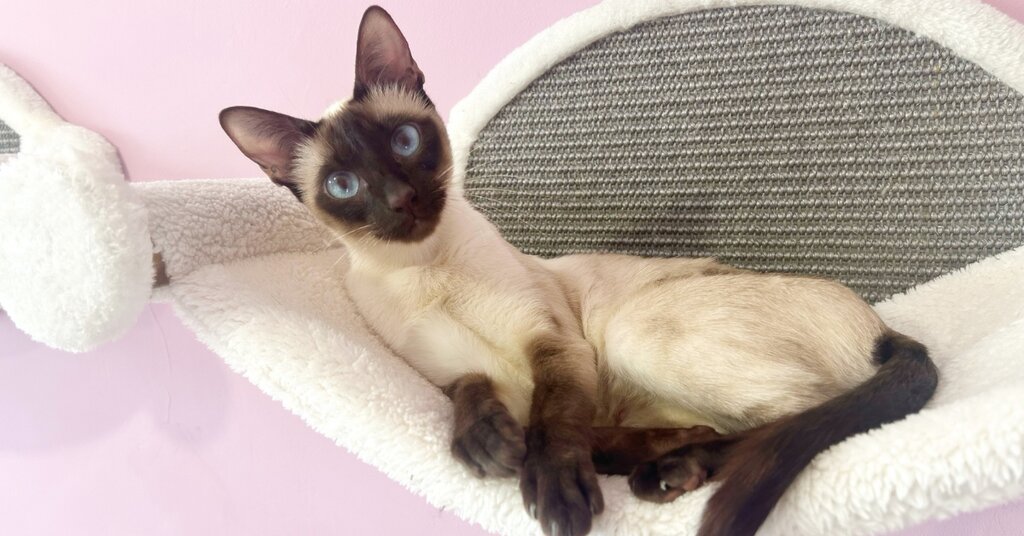
How to bring the volume down
You are not trying to silence the cat. You are trying to stop the noise being the best way to get what it wants.
Stop paying for the demand meow. When your cat yells for food or attention, wait for a few seconds of quiet, then give it what it wanted. It feels heartless the first week. By the second, most cats have worked out the new rules, because they are clever enough to.
Get ahead of the boredom. Two short play sessions a day with a wand toy, where the cat gets to stalk, chase and catch, do more for the noise than anything you can buy. Feed some meals from a puzzle feeder. Give it a window to watch. My article on keeping indoor cats happy has plenty more ideas.
Fix the 5am alarm call. Play hard in the evening, then feed a meal straight after, which is how a cat naturally winds down: hunt, eat, groom, sleep. If breakfast is still the issue, a timed feeder means the bowl serves breakfast, not you, and the cat stops shouting at the person in bed.
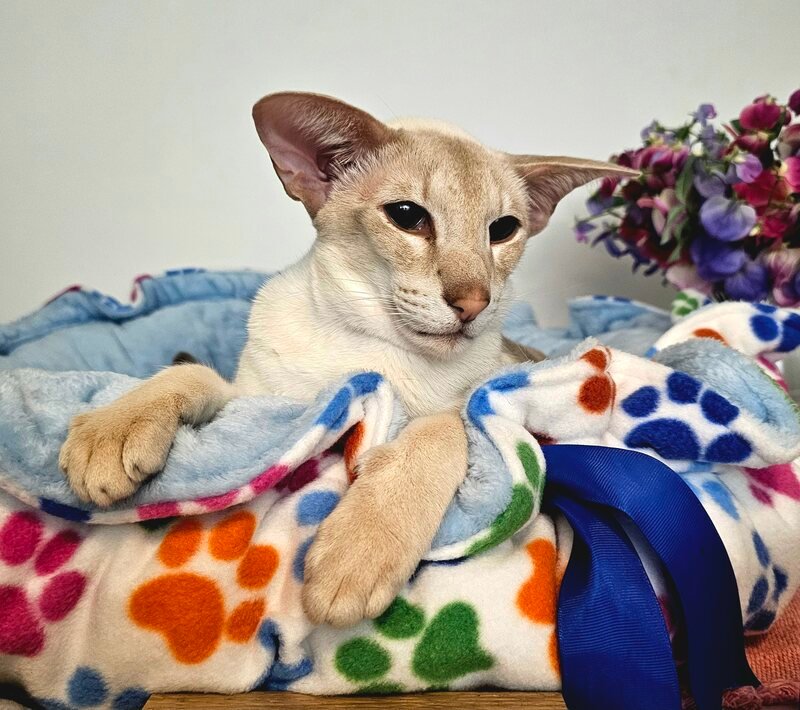
Think about company. A Siamese that is lonely will tell you about it. If you are out for part of the day, a second cat is often the quietest thing you will ever buy (two Siamese talk to each other, which is not the same as both talking to you). My article on whether Siamese cats get along with other cats covers choosing and introducing one.
Do Siamese cats get quieter with age?
Some settle a little once they are past the madness of the first couple of years. Plenty do not. What should never happen is a sudden change, louder or quieter, in an older cat without a reason, and that is a vet check, not a training problem.
What will make it worse
Shouting back. To a Siamese, that is a conversation, and you have just joined in.
Punishment of any kind. Water sprays and loud claps do not teach a cat to be quiet. They teach it to be frightened of you, and a frightened Siamese is usually a louder one.
Giving in after twenty minutes. If you hold out for nineteen and then cave, you have taught the cat that the price of breakfast is twenty minutes of yelling. Every time you do it, the price goes up.
If you are at the end of your tether
Sometimes the noise is a symptom of a cat that is stressed, anxious or unhappy, and the fix is not a toy. My guide to stress in cats is a good place to start, and my book The Calm Cat goes through it step by step. If the noise is worst when you leave the house, read my guide to whether Siamese cats can be left alone.
And if you have tried all of it and you are still being shouted at, get in touch through my contact page. I do still do behaviour home visits, and a lot can change once someone sees the cat in its own home.
Your questions about Siamese noise
Are Siamese cats the loudest breed?
They are widely regarded as one of the most vocal breeds there is, and the Oriental and the Balinese are right there with them, because they are the same breed group. Volume and chattiness vary from cat to cat, but you will not find a quiet branch of the family.
Why does my Siamese sound like a baby crying?
The Siamese voice is famously raspy and penetrating, and plenty of owners say it sounds like a baby. It is not distress in itself. Listen for the context instead: a cry in the litter tray or a new night-time cry is worth a vet check, a cry at the fridge is not.
Do Siamese cats purr?
Yes, and often loudly. Purring usually means contentment, though cats can also purr when unwell or stressed, so read it alongside everything else your cat is doing.
Will a second cat make the house louder?
Usually the opposite. Two Siamese entertain each other, so the attention-seeking aimed at you tends to drop. You may hear them chattering to each other, but that is a very different thing from being shouted at for breakfast.
Can I stop my Siamese meowing completely?
No, and please do not try. Aim for less noise, at better times, about better things. A Siamese that never talked would be a Siamese with something wrong.
Is a Siamese too loud for you?
That is a fair question, and it is better asked before the kitten comes home than after.
If you work nights, have a baby who sleeps badly, or simply value a quiet house, a Siamese, Oriental or Balinese will test you every day. There is no shame in choosing a quieter breed. My honest guide to whether a Siamese is right for you will help you decide, and it has a quiz that does not pull its punches.
If you have read all this and smiled, you are the right kind of owner. I am writing a book about living with Siamese, Orientals and Balinese, noise and all. Join the newsletter below to hear first when it is out.