
Living with cats, I know the long-standing debate only too well: indoor or outdoor? My cats are indoor cats, but I always wanted to give them the freedom to enjoy fresh air and sunshine safely. That is exactly what a well-built cat run does – it gives your cats the best of the outdoors without the very real risks of roads, predators, theft, disease and simply wandering off and getting lost.
When our new kitten arrived – the boy who would grow up to be our stud – it sealed the deal. Below I share exactly how we built our run and cat house from scratch, what worked, and the safety points I would never cut corners on.
Why Build a Cat Run at All?
Before you lift a single panel, be clear about who will use the run and how. The design changes completely depending on the answer. If you are building a simple exercise run for your pet cats, you will want it close to the house so the cats can come and go easily. If you are building living quarters for a stud, a secure, comfortable, weatherproof house becomes far more important than convenience.
For us it was the latter, but the principles overlap. Either way, the four things I care about most are the same: it must be genuinely escape-proof, it must offer shelter from rain and wind, it must provide shade in hot weather, and it must be easy to keep clean. Get those four right and everything else is detail.
Where to Build a Cat Run
After looking at commercially produced runs, we decided we could build our own to suit our needs perfectly and save a considerable amount of money in the process. We chose a corner of the garden already enclosed on three sides by walls. That gave us an area that was easy to pen in, naturally secure and nicely sheltered from the wind – and because we only needed to mesh one side and the roof, we made an instant saving on materials.
The spot was also overlooked by our kitchen window, which has been invaluable. It let our boy get accustomed to his run gradually while we kept a close eye on him, and the window doubles as free access to the outdoors for our other cats. If you can position your run where you can see it from the house, do.
Building the Cat Run
For the frame we used 3×2 inch tantalised (pressure-treated) timber to create panels roughly a metre wide and two metres high, though your exact dimensions will depend on the size of your mesh sheets. A strong one-inch welded galvanised mesh was stretched across each panel and stapled into place.
This is the single most important component, so do not skimp. The mesh is the one thing keeping your cat safely inside, so spend the money on good-quality, strong, galvanised mesh rated for outdoor use. Cheap mesh rusts, sags and fails – and an escaped cat is exactly what the whole project exists to prevent.
If other cats roam your garden, consider fitting sneeze barriers around the base of the run. These are solid timber or perspex panels rising roughly two to three feet from the ground, and they help stop the spread of infections such as cat flu between cats on either side of the mesh. For any breeding household, they are well worth the effort.
For the floor, paving stones, grass or concrete all work well. Cats love grass, but it needs regular upkeep, whereas paving and concrete are far easier to keep clean. Our ground was very uneven concrete, so we built a raised decked base instead – which gave us a level surface and a handy storage area underneath for litter, transport boxes and odds and ends. When using decking, leave roughly a screw’s width between boards to allow for expansion.
That gap is fine for an exercise area, but if you have a stud or a cat that sprays, seal and waterproof the base for easy cleaning. We laid a plastic membrane under the decking, then sandwiched it with marine plywood, and sealed the gaps between boards with clear silicone so the whole thing can simply be hosed down and scrubbed.
For the roof, we covered half in mesh and half in transparent perspex. That gives a sheltered, dry area and an open-air area in one – so the cats always have a choice. We sloped the perspex so rainwater runs off into a gutter that drains away, keeping the run dry underfoot. Finally we built a timber-and-mesh gate with a padlock on each side, so we can lock the cats in securely and lock the door behind us from inside the run. A double-gate or safety-porch arrangement like this massively reduces the chance of a cat slipping past you as you come and go.
The Cat House
Whether you need a cat house at all depends on how the run will be used. For a simple exercise space where the cats have free access in and out of your home, a house is probably not necessary. But if your cat will spend real time out there – especially overnight or in our often grim British weather – it needs a properly sheltered space, anything from a cosy insulated den to a fully heated house.
Building Your Own Cat House
In the past we built our own using a small raised-shelter design. We made a frame roughly two metres long by one metre wide from 3×2 inch treated timber, with the legs forming part of the structure and lifting the house a metre off the ground – which also gave a metre of height inside.
For a simple summer napping spot, you could just clad the sides and base in timber. But insulation is easy and makes a huge difference, creating a warm, draught-free space. We packed Kingspan thermal insulation between the frame struts (rockwool is a cheaper alternative), clad the outside in timber and the inside in marine or white plastic-faced plywood, and fitted a perspex window so the cats could watch the world go by. A timber door with a cat flap and a small shelf to jump onto completed it, and the felt-covered roof was sloped backwards with an overhang so rain runs away from the house.
Buying a Cat House
For a run used regularly, overnight, or through the colder months, I would strongly recommend an insulated and heated house. As our boy would eventually live outside, a large, warm house was a priority, so we bought a professionally built one with insulation and easy-clean polypropylene-lined walls – more like a shed, with room for me to get inside for cleaning and to spend time with him.
Companies can supply easily assembled houses and runs with extras such as shelves, cat flaps, lighting and double glazing. We finished ours with durable non-slip lino, a warm covered bed on the shelf, and a litter tray tucked underneath.
If your cat will spend time out there, heating is essential. We use a fibreglass heater and there are also tube heaters and infra-red options. Whatever you choose, monitor the temperature carefully with a thermostat or thermometer so it never becomes uncomfortably hot or cold – just as you would adjust your own central heating with the seasons.
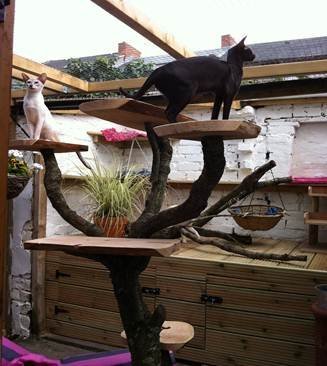
Once you have a safe, comfortable space, the fun part begins: kitting it out with shelves, platforms and outdoor cat furniture for them to climb and lounge on.
Frequently Asked Questions
How do I make a cat run truly escape-proof?
Use strong galvanised welded mesh on every open side and across the roof – never leave the top open, as cats climb. Make sure there are no gaps at the base, fit a self-closing gate (ideally with a porch or double-gate arrangement), and check the whole structure regularly for damaged mesh or loose fixings.
Do I need planning permission for a cat run in the UK?
Most modest cat runs fall under permitted development, but rules vary with size, height and where you live – and listed buildings or conservation areas have extra restrictions. I would always check with your local council’s planning department before building anything substantial. Treat this as general guidance, not a definitive ruling.
How do I keep my cats warm in winter?
Insulate the cat house, provide a heated bed or a thermostatically controlled heater, keep it draught-free, and monitor the temperature with a thermometer. For very cold spells, many owners bring cats indoors overnight. Never rely on an unmonitored heat source.
Is a cat run better than letting a cat roam free?
For many owners, yes. A run gives cats fresh air, sunshine and stimulation while protecting them from traffic, theft, fights, predators and infectious disease. It is an excellent middle ground between a strictly indoor life and the risks of free roaming.
Want more practical owner advice?
From outdoor enclosures to everyday care, our Owners’ Guide is packed with honest, hands-on guidance.
For more on building a stimulating, safe home environment, International Cat Care’s family and home life advice is an excellent, evidence-based resource. You may also like our guides to keeping indoor cats happy, the indoor or outdoor cat debate, and our wider Owners’ Guide.
Written by Ross, lifelong cat breeder and owner. Find out more about me and this site here.