
A missing cat poster is one of those things we all pray we will never need. But if the worst happens and one of our cats goes missing, a good lost cat poster is one of the most powerful tools you have. It tells your neighbours your cat is missing, that you are searching, and that they can help. In my experience most people are genuinely kind and want to help reunite a lost pet with its owner – a clear poster simply gives them the chance.
If you are reading this because your cat is missing right now, I am so sorry. You are probably worried sick and just want to download a template, fill it in and get it up on the wall. So let me give you exactly that, then walk you through how to make it as effective as possible and where to put it.
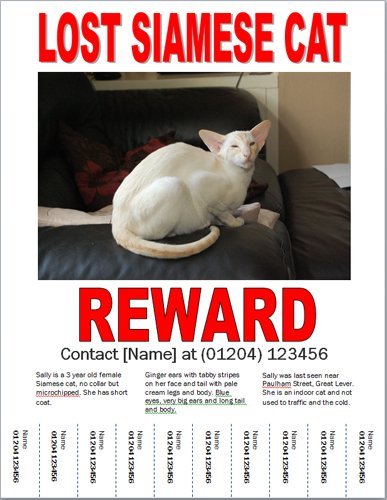
A Free Missing Cat Poster Template
I have made a free missing cat poster template that you are welcome to download and use. It is a Microsoft Word document with editable fields, so it is quick and easy to drop in your own photo and details and have a finished poster ready to print in minutes. You can grab it here:
Download the free missing cat poster template →
It is completely free to use – please share it with anyone who needs it. Below I have set out the best things to include on your poster and why, followed by where to display it for the greatest chance of bringing your cat home.
A Photograph of Your Cat
I cannot stress this enough: a clear photograph is the single most important thing on your poster. Most people will only glance at it as they walk past, and many will not read the written description at all. The photo does the heavy lifting. Choose a close-up that shows your cat’s face, with eyes open, and as much of the body as possible. A bright, clear, recent picture is far more useful than a flattering one.
The Layout That Works Best
Keep it simple and bold. From the top of the page down:
- Start with LOST CAT in large capital letters – bold red text in a plain font such as Arial works well.
- Then the photograph, which should dominate the page.
- Next, the word REWARD, again in capitals, if you are offering one.
- Your contact details – name and phone number only.
- Below that, in smaller text, a short description of your cat and where it was last seen.
- Finally, tear-off slips along the bottom with your name and phone number.
Remember, people will only glance. You need them to take in three things instantly: LOST CAT, the photo (they may have seen your cat without realising it was lost) and REWARD. Those three pull them in to read the rest.
Offering a reward really can make the difference. Someone may have taken your cat in, or even taken it deliberately, and a reward can tempt them to make contact. Children in particular will hunt high and low if a reward is on offer – so be ready for plenty of calls, which is exactly why a clear photo and description matter. When you add your phone number, make it easy to find, and do consider those tear-off slips. I would always advise against putting your home address on the poster.
Writing a Description Anyone Can Use
The photo gives people the picture; the description fills in the detail they might miss at a glance. But here is the key thing many breeders get wrong: most people do not own cats, and even fewer own pedigrees. Show-ring language will lose them completely.
Bad example: “Mature Red Point Siamese queen of show-winning type. Vivid blue eyes, straight profile and good chin. Excellent points colour with a clear coat, lying close. Whippy tail, tall legs and an elegant frame.”
Good example: “Three-year-old Siamese cat with a short coat. No collar but microchipped. She has ginger ears, ginger tabby stripes on her face and tail, and a pale white/cream coat and legs. Blue eyes, a long face, very big ears, and long legs, body and tail.”
Describe what a non-cat person would actually see. Swap the jargon for plain words: blue becomes grey, red becomes ginger, havana becomes brown, apricot becomes ginger. Just say what you see. And at the end of the description, always add where your cat was last seen, plus any urgent plea – for example that she is an indoor cat with no road sense, or that he is on daily medication. Mention whether your cat was wearing a collar and, crucially, whether it is microchipped.
Is Your Poster Fit for Purpose?
For a shop window or indoor noticeboard, a sheet of A4 paper is fine. Outdoors, you need to protect it from the British weather – slip it inside a clear plastic wallet to keep off the rain and wind. If you are fixing it to a lamp post, mount it on card to keep it rigid, or the wind will wrap it round the post and nobody will be able to read it.
Where to Display a Missing Cat Poster
Where you put your posters matters just as much as how they look. There is no point following every tip above if nobody ever sees them. Start within roughly a two-mile radius of where your cat went missing, and widen the area later if you need to.
Display posters at a height that suits everyone – young and old, tall and short – and remember drivers waiting at traffic lights are sitting down. Target the busy spots: post offices, supermarkets, newsagents, off-licences, corner shops, vets and pet shops. Hand-deliver flyers door to door, and pop them under the wipers of parked cars. If a shop will not let you display inside, use the nearest visible lamp post outside – as long as people see it, that is what counts.
Lamp posts and railings at junctions catch both pedestrians and drivers, and a good number of those people will live locally. One more tip that sounds odd but works: consider making your poster before your cat is ever lost. You will have a calm choice of good photos, you can write the description with your cat sitting right in front of you, and if the worst ever happens you will not be trying to design a poster while frantic with worry.
Finally – and I hope this is how it ends for you – once your cat is home, whether through your posters or because a vet or rescue scanned a microchip, do go round and take the posters down. Thank the shopkeepers and everyone who helped. You never know when you might need their goodwill again.
Frequently Asked Questions
What is the most important thing on a missing cat poster?
A clear, recent photograph. Most people only glance at a poster and will recognise your cat from the picture far sooner than from any written description. Make the photo big, bright and front and centre.
Should I offer a reward?
It can genuinely help. A reward encourages people to make contact, including anyone who has taken your cat in. Keep the amount sensible, put the word REWARD in capitals near the top, and be prepared for a flurry of calls – which is where a good photo and description help you sort genuine sightings from hopeful ones.
How far should I put posters out?
Begin within about a two-mile radius of where your cat went missing and widen it if needed. Cats often stay closer to home than owners expect, so saturate the immediate streets first.
What should I do as well as putting up posters?
Make sure your cat’s microchip details are up to date, contact local vets and rescue centres, and ask neighbours to check sheds, garages and outbuildings where a frightened cat may be hiding. Microchipping is one of the best ways a lost cat gets reunited with its owner.
More help for worried owners
From finding a lost cat to everyday care, our Owners’ Guide is full of honest, practical advice.
For trusted advice on microchipping and keeping cats safe, the GCCF’s Keeping Cats Safe guidance is a reliable place to start. You may also find our own guides helpful: how can I find my cat, keeping indoor cats happy, and the indoor or outdoor cat debate, plus our wider Owners’ Guide.
Written by Ross, lifelong cat breeder and owner. Find out more about me and this site here.